Wednesday, April 13, 2016

Visitors, a Somber Site, a Spirited Gathering, a Trip, and Signs of Spring

Visitors, a Somber Site, a Spirited Gathering, a Trip, and Signs of Spring

Visitors from Charlotte

Good friends Dean and Leigh Williams from Charlotte, North Carolina, arrived recently to experience a bit of Poznan and Poland for themselves. As is often the case, even an ambitious schedule of activities permits only a cursory exploration of this great city and fascinating country. We began with a walking tour of Poznan under the guidance of friend and Poznan native Monika who provided detailed historical context for the many significant sites in the city. In fact, 5-6 hours of touring served only to whet our appetite to learn more.
Our guide, Monika, explains the architecture of Poznan's "Stary Rynek" (Old Market Square) to Dean and Leigh Williams, visiting from Charlotte, North Carolina. The model is actually intended for the blind so they can experience the beauty of the square around them through touch. Next to each building in the model is a Braille explanation of its significance.

We visited and paid our respects at one of Poznan's less frequented spots -- Fort VII. The fortification, built in the latter half of the 19th century, was one of a string of forts designed to defend the city from attack. Poznan was then part of Prussia. The site is far more prominent now because, tragically, from 1939-1944, Fort VII became a Nazi concentration camp. As a Gestapo prison, the fortress's name became "Security Police Prison and Correctional Labor Camp." Its informal name, though, was "a camp of bloody revenge." It became the largest Nazi camp for the extermination of Polish elites in the region. Prisoners/victims were largely the intelligentsia: professors and teachers; political and social leaders; veterans of several uprisings; anyone suspected of underground activitiy; and members of the clergy. The Nazis referred to this as "political cleansing." Jews were also interred here and were forced to dig up and burn bodies buried in mass graves around Poznan; this was to cover up Nazi crimes. As many as 40,000 prisoners were held here, and estimates are that 4,500 were murdered or died in prison. There is much more to say about this place of horror, but I will not dwell on it here. If you wish, you may learn more here: Fort VII Poznan.

The ominous description of Fort VII's notorious past.


Fort VII's network of bunkers and ramparts was originally used to support defensive gun emplacements.  
The entrance to a bunker, used by the Nazis to house prisoners.


A memorial in one of the prisoner cells notes the names of some of those murdered in Fort VII from 1939-1944. As many as 200 prisoners were housed in a single cell.
Sculptures memorialize the victims.


Against this wall, prisoners were shot to death. A few bullet holes are still visible at upper right, though a wooden wall was erected behind the condemned prisoners to prevent ricochets. 
Turning to more pleasant topics, we have put our visitors to work during their all-to-brief stay in Poznan. Dean provided a guest lecture to more than 50 students at the Poznan University of Economics. His topic was "Potential, Passion and Purpose - Finding a Fulfilling and Impactful Life." The overflow group of students learned from Dean techniques for finding a place in life that reflects the intersection of potential to excel, passion for vocation, and clear, transformative purpose. Dean also spoke to a gathering of university students from our church at our home one evening. The students represented a litany of countries: Belgium, the Bahamas, the Democratic Republic of Congo, Pakistan, Sri Lanka, Russia, Canada and the Netherlands. The students are united by their faith and meet regularly for discussion, study and recreation. We were honored to host this gathering.

Dean Williams about to speak to 50+ Polish students at the Poznan University of Economics.


Students were intently interested in Dean Williams' insights.


Dean employs a student volunteer to demonstrate the relationship between balance and focus.
A gathering in our Poznan apartment of university students from our church here. The nine people in the foreground represent nine countries. Robin and Leigh are in the background, left, preparing a buffet supper for the group.
Dean shared his advice and counsel with the students.
This upcoming Saturday, Leigh Williams will join my wife, Robin, in helping to lead a ladies' retreat planned and organized by our church here. The half-day retreat will be held in the cathedral in nearby Gniezno, Poland, the first capital of the country and the place where just over 1,000 years ago, Christianity was introduced to what was then a loose alliance of Polish tribes. 

Quick Trip to Malta

Robin and I recently took advantage of a few days' Easter break and inexpensive flights between Poznan and the Mediterranean island nation of Malta. The 3-hour flight took us to a country we had not previously visited. We were enthralled with the history of this important island, just 17 x 9 miles (27 x 14.5 km) and with a population under a half million. The Apostle Paul was shipwrecked here nearly 1,000 years ago (see Acts 28). Paul met with the Roman governor, and the Maltese credit that encounter with introducing Christianity to the island. Today, Malta is home to a vast collection of magnificent churches.

The view from our hotel balcony in Malta.

A twilight dinner on our first evening in Malta.
The famous Knights of Malta in the 16th century withstood a siege by the Ottoman Empire and continued to rule until defeated by Napoleon in 1798. The Knights, descendants of the Order of Saint John the Baptist, were "Hospitallers" and constructed a highly advanced hospital on Malta (Sacra Infermeria) around 1574 with a capacity of more than 600 beds. Exceptional for the time, the hospital accepted women, slaves and non-Catholics.

Beautiful but rugged coastline characterizes most of the island.
This 16th century hospital was ahead of its time in medical innovation. The former hospital now hosts receptions and is a popular tour destination.
A pleasant cafe in the Maltese capital of Valletta.

A narrow street in the Maltese capital.
During World War II, when Malta was part of the British Empire, the island's strategic importance led to destructive bombing by the Nazis, but its ports and airfields permitted the interdiction of German shipping to the North African theater of operations.

The weather was slightly cool and blustery, but the sun was warming and pleasant. It was a busy few days as there is much to see. It was a welcome break, but now I'm back to classes and other projects here in Poznan.

Signs of Spring

I will leave you with a few images of the promise of the season. A few warm days last week -- temperatures topped 70 degrees Fahrenheit one day (around 20 Celsius) -- introduced a welcome change following a long, dreary winter. The face of Poznan is changing dramatically with the turn in the weather. Temperatures have returned to more seasonable upper 50's (around 14 Celsius), but the citizens of Poznan are determined that winter is over. 

The outdoor cafes in the Stary Rynek appeared just in time to benefit from the unseasonably warm weather last week.
Picturesque skies and mild temperatures help showcase the beauty of Poznan.


A rare warm day in early spring brings out Poznanians to bask along the Warta River.
Valiant kayakers paddle against the flow of the Warta River that meanders through Poznan.

The automated bicycle rental stands are now fully stocked. It's my preferred means of transportation home from work.


That's enough for today. Thanks for your visit, and do widzenia.


Wednesday, March 23, 2016

What Just Happened?

What Just Happened?

Owing to a confluence of selected principles of orbital mechanics and solid geometry, we recently experienced an extraordinary, even miraculous event. The blend of the earth's elliptical orbit around the sun, the 23 1/2 degree tilt of the earth's axis to that orbital plane, and the planet's equatorial rotational speed of roughly 465.1 meters per second (just over 1,000 miles per hour) conspired to create a precise instant, (5:30 a.m. on Sunday, March 20, in Poznan, Poland) called the Vernal Equinox. Vernal from the Latin for spring, equinox combining the Latin for equal and night. Spring has arrived. Of course, for my readers south of the equator, you just experienced the Autumnal Equinox, but I don't want to make this too confusing. That said, the assumption that this event is accompanied by flowering trees, sunshine, and bright, pleasantly warm days appears to be somewhat premature. As the screen shot below suggests, as I write this, it is 4 degrees Celsius in Poznan (39 degrees Fahrenheit) in the early afternoon with chilly rain forecast later. There is a slight warming trend in the days ahead, but the long-range forecast has us drifting below freezing again in early April. 


Ah, well, it's still great to be here, and all too soon -- less than four months now -- our Fulbright fellowship in Poland will draw to a close just as the summer high season will be at its apex. So we will patiently watch for those more tangible and experiential harbingers of spring.

Academic Activities

Summer classes are now five weeks spent with about 12 weeks remaining. My two formal classes have settled into comfortable size of 25 students each now that drops and enrollments have ended. My Friday morning informal seminar has gained a couple participants, so the combination of prep, grading, writing projects and other responsibilities keeps my days (and some evenings) pleasantly active and purposeful. 

On a recent Saturday, I again led a half-day seminar for professionals pursuing weekend master's degrees. This time the topic was internal/employee communication, and I focused on organizing and planning for internal communication programs. Given nearly four hours, I include a variety of teaching approaches: lecture, discussion, video clips, small-group problem solving, case studies, etc. All 12 students were Polish, so I admire tremendously their ability to stay focused and engaged after a full work week as I teach in English. Their active participation in class activities tells me they found the session useful.

Freitag lecturing on internal/employee communication to Polish graduate students.

Graduate students working in small groups to address a case study problem.
We have a respite from classes this week Thursday and Friday as part of the Easter break. My classes will resume March 24. 

A Quick Trip to Szczecin

Robin and I carved out three days for a train trip to the northwest Polish city of Szczecin (for non-Polish speakers, just say Stetson, like the cowboy hats, and you'll be close enough). This beautiful city near the Baltic coast and the German border has a storied, sometimes tragic history, and proved a delightful addition to our list of fine Polish cities visited. Over the centuries, Szczecin (Stettin in its German form) has been under the control of Sweden, the Holy Roman Empire, Denmark, the German Empire, the Kingdom of Prussia (as part of the province of Pomerania), Nazi Germany, and only became part of the People's Republic of Poland in 1945, then the Republic of Poland in 1989. Sadly, during World War II, as many as 15,000 Polish slave workers served in Nazi manufacturing plants in Szczecin. You may recall Winston Churchill's seminal "Iron Curtain Speech" in which he declared, "From Stettin in the Baltic to Trieste in the Adriatic an iron curtain has descended across the Continent." Anti-communist demonstrations grew in Szczecin during the 1980s despite the imposition in Poland of martial law. Pope John Paul II's visit in 1987 intensified sentiment and activities in that direction, culminating in strikes and eventual free elections in Poland in 1989.

Now, Szczecin is a thriving city of more than 400,000, with ports handling more than 10 million tons of cargo annually. Its nicely restored ducal castle, extensive Renaissance and Gothic architecture from the late 19th and very early 20th centuries, and countless churches and cathedrals make this a splendid city to explore. Fair but chilly weather permitted us to take in a great deal, though we lacked adequate time to enjoy the impressive list of intriguing museums. 

A few of our photos are below, but our full array of photos from Szczecin may be viewed here: Szczecin Photos.

The Ducal Castle, built originally in the 14th century, then reconstructed several times since. It was 60% destroyed during World War II, then reconstructed according to its 17th century design.


We enjoyed lunch in the restaurant now enclosed within the Ducal Castle.

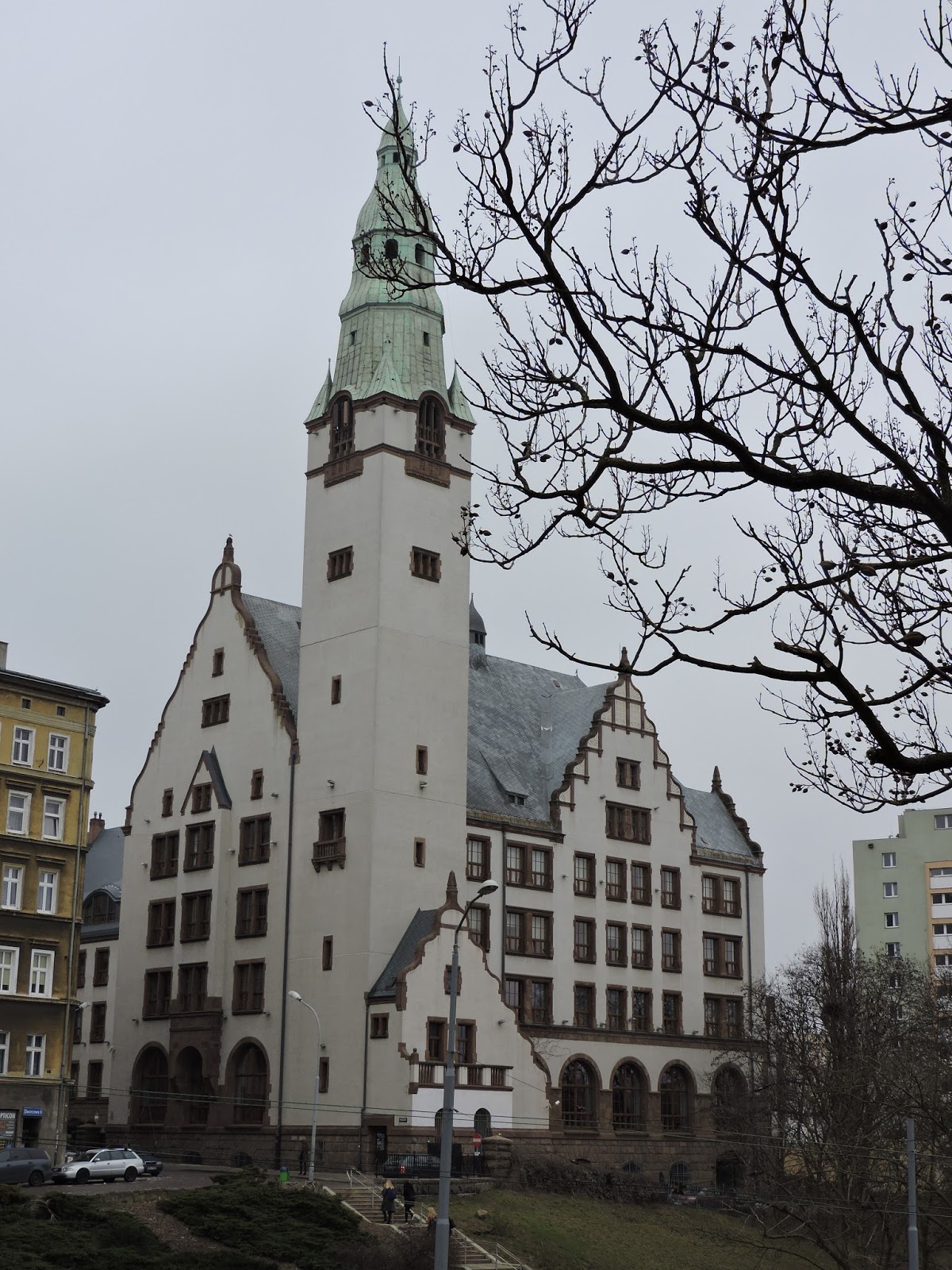
A former residence, now an art school.

A building now housing apartments and shops.

Stepping inside many of the beautiful buildings reveals spectacular interiors. This is a County office building.

A County office building.


Night view of the National Museum in Szczecin.

Alan bundled against the cold in a riverside park. The National Museum is in the background.


Another spectacular interior.

I have no recollection of what this building is, but it's a beauty!

Touring the city on foot is a breeze. The Tourist Information Office offers detailed maps that indicate several tour routes, each color-coded on the map. The corresponding colored lines are clearly visible along the routes.


The color-coded lines take visitors to the key attractions in Szczecin.

Numbers along the way correspond to detailed explanations in the guidebook, augmented by posted plaques.
Szczecin features many beautiful fountains, unfortunately not operating in winter.

We visited just one museum, the Museum of Technology and Transport. It features an extensive collection of Polish-built vehicles of the last century. It seems this industrial sector was blooming and poised to excel in the 1930s, but was interrupted by the outbreak of war in 1939.

Robin cozying up to a whimsical statue in one of the parks.

Blessed by sunshine on our final day in Szczecin.

The city is home to many magnificent churches and cathedrals.

This is a hard working port city with constant traffic on the river leading to the Baltic Sea.


I think that's enough boring vacation photos to share for now. We still have further travel plans in our remaining 14 weeks, so brace yourself for more of the same. We're also eagerly anticipating several visits from friends and colleagues in the U.S. Please continue enjoying these blog entries, with my gratitude. Do widzenia!

Monday, February 29, 2016

Past the Midpoint

Past the Midpoint

We have now completed five months of our 10-month adventure here in Poznan. Although our lives have settled into a somewhat predictable routine, we are no less thrilled at this amazing opportunity. We have accomplished a lot, as my previous 12 posts attest, but there are many things remaining on our agenda and diminishing time in which to achieve them.

The weather has been reminding us lately that the calendar says there's plenty of winter left. Temperatures have been hovering at or slightly above and below freezing for some time, with only a slight warming pattern slated for the days ahead. Cold rain and drizzle have been regular companions, and yesterday saw a sleet storm, two brief snow storms, gusty winds, blue sky and sunshine all in the course of two hours. It's easy to predict when the worst weather will hit -- it's always when I'm lugging a heavy computer bag, a couple portfolios and a camera while trying to hold on firmly to an umbrella, walking to or from the tram or class in another building and dodging traffic. On the other hand, visible now are the first green buds of spring on the shrubbery in parks and gardens. We just need to hold out a little while longer before the earth explodes in its finest spring frippery. 

The view from a classroom window this week during a sudden midday storm that combined snow and sleet (sneet?). Within 15 minutes the sky was sunny and blue, though the temperature remained around the freezing mark.

Teaching and Other Student Encounters

After a short break, the "summer" semester has begun, and we are already two weeks into the term, which will continue through mid-June -- hence the "summer" moniker, though the designation doesn't seem quite so apt in February in Poland. I'm teaching two classes, International Public Relations and Corporate Communication (which I am choosing to focus on internal/employee communication). Each class has around 25 students, all exchange students as was the case during the winter semester recently ended. In addition to the same European and Asian countries represented in my classes during the previous semester, I now have students from Greece, Russia, Armenia and Belarus.

I continue to seek additional opportunities to engage in the life of the university here and participated as a panel member leading a discussion on "Internationalizing Poznan" earlier this week. About 50 exchange students attended, and I was joined on the panel by three representatives of Poznan government agencies. It was a fascinating discussion on steps Poznan might consider to contribute to its growing appeal as a destination for business, tourism and academic exchange.

I was one of four panelists discussing "Internationalizing Poznan." The three young men on the right are students who helped organize and moderate the event (two from Egypt, one from Peru), attended by roughly 50 exchange students and university officials.


Also this week, I accepted an invitation to meet with a group of gifted and ambitious graduate and undergraduate business students, members of a club called "ASAP." The group augments their already demanding academic agenda by inviting guest speakers, with a focus on native English speakers, to lead discussions related to contemporary business practices. I spent 90 minutes with the group talking about the importance of building an organizational culture of trust and openness through effective internal communication structures, procedures and policies. My hope is that these future CEO's will incorporate these concepts into their business visions and approaches in the years ahead.

Meeting with "ASAP," a student-led business club.


A Brief Roman Holiday

During the week between semesters, Robin and I squeezed in a few days in Rome. Direct flights from Poznan to many European destinations on low-cost airlines are a constant temptation, and the 2-hour flight to Rome was irresistible. Robin had been to Rome more than 30 years ago, and I have been to other parts of Italy, but this was my first visit to the historical capital. We booked a small, pleasant hotel in the Vio Veneto district, close to prime tourist attractions such as Trevi Fountain and the Spanish Steps (under repair and blocked off during our visit). In January, tourist levels are down and the weather is pleasant enough to permit comfortable walking to many attractions. While hours-long lines characterize peak tourist season, we waited in very short lines and sometimes no lines at all for sites such as the Colosseum, the Catacombs, Palatine Hill, even the Vatican, including St. Peter's Basilica and the Sistene Chapel. Restaurants and coffee shops were always available without reservations thanks to the absence of tourists. I've included a few photos below, but for an overdose of our snaps, visit this Drop Box site: Alan and Robin's Rome Pix


More of Poznan's Cultural Scene

Earlier this week, the Academy of Music here hosted an exceptional performance of all five of Beethoven's piano concerti over two splendid evenings. With a world-class pianist and a 40-piece orchestra, the experience was mesmerizing. What an extraordinary feat for a pianist -- to perform the five concerti in succession over two evenings. As always with events at the Academy, the quality was superb. And the cost? As always, free. This is an amazing place for lovers of fine music.

The pianist and the orchestra receive well-earned appreciation from a grateful audience.

Leaving Our Footprint

One final note -- we were graciously invited recently to the home of one of my colleagues in the department in which I'm teaching here at the Poznan University of Economics. Dr. Jacek Trebecki, with whom I have collaborated on a number of research, writing and teaching projects, invited us to dinner at a wonderful local neighborhood restaurant then to his home for tea and dessert. It was my privilege to provide Jacek, his wife, Asia, and their three great children with souvenirs of my home university. They obligingly posed for the photo below.


That's a wrap for this edition of the blog. Thank you most kindly for your visit, and I hope you'll drop in again. Do widzenia!

Wednesday, February 3, 2016

Winter Semester Winding Down

Winter Semester Winding Down

The winter term that began in mid-September is drawing to a close, with exams and final presentations defining last week and this. Students in both my classes cap their experiences with group presentations based on final projects designed to encapsulate their accumulated knowledge during the past 16 weeks.

In Internal Communication, student groups of four or five (there are 40+ students in the class) were tasked to prepare a comprehensive internal communication policy document for an organization of their choice. The document had to address policies and procedures for such areas as organizational communication goals, employee use of social media, delegation of communication responsibilities, an explanation of internal communication channels, protocols for external communication activities of employees, fundamental guidance for crisis communication, a framework for communication training for employees, procedures for gauging internal communication effectiveness, plus a few other components. The student groups had to submit a professional quality document and share a 15-minute summary presentation with the class. Half the teams completed their presentations last week, and the remaining presentations occurred Monday, February 1. This has been a considerable challenge for the students, but they attacked it with vitality and keen interest. Hardly any had any previous exposure to public relations; most are pursuing degrees in business. They tell me they had not previously appreciated either the weighty significance of effective employee communication, nor had they considered the value of carefully crafted and published organizational policies to guide and manage internal communication. It is my hope that students in this class, representing roughly a dozen countries in Europe, South America and Asia, will increasingly introduce these concepts into their continued studies and approaching professional careers in their home countries.

An Internal Communication student team presents on its chosen organization, Mercedes Benz Customer Service.


This Internal Communication team developed a policy document for a small UK brewery.
Other organizations for which students developed internal communication policies included Ferrari, NestlĂ©, our own Poznan University of Economics and several other corporations and nonprofits. I was deeply impressed with the way the presentations and the policy documents reflected gained knowledge. Especially impressive is the fact that the projects and the presentations were in English -- not the primary language for any of these students.

In International Public Relations, I provided students with a scenario: They were representatives of a public relations team retained by a company headquartered in Mumbai, India. The fictitious company manufactures plastic tubing (used for toothpaste, hand cream, suntan lotion, etc.). The company was expanding globally, and the PR team was charged with preparing a report on the communication challenges the Indian company would face when establishing operations in each team's assigned country (Argentina, the Philippines, Vietnam, etc.). So each team needed to assess the cultural and structural differences between India and the team's assigned country as those differences affected communication related to the business venture. For example, teams needed to research and report on interpersonal communication variances, differences in media structures, comparative legal issues pertaining to public relations (copyright, privacy, etc.), even the nature of public relations practice. Their reports also had to suggest approaches the company might take in accommodating differences. The students did a splendid job, and both the reports and the presentations were worthy of the corporate setting. Again, students worked entirely in English.

This group described the challenges the Indian company would face in expanding in Argentina. The students in the group are from Vietnam, France, Romania and Italy.


Here a student group presents a summary of its report on plans to expand in South Africa. The students come from France, Germany, Ukraine and Bulgaria.

It is extremely gratifying to see groups of promising and gifted young men and women able to work together so successfully, solving challenging issues despite the vast differences in their own cultures and experiences.

One side note -- this is the view from the classroom in which I taught this term now ending. One entire wall of the classroom in this magnificent new university building is glass, and the view can be distracting. Across the street on the right side are other university buildings. The rounded building on the left side is the exceptionally beautiful performing arts center for the Academy of Music, one of the most highly regarded in the world. Past the intersection in the center is the Zamek (Polish for castle). It was constructed from 1905-1910 under German Emperor William II. Poland regained its independence following World War I (it had been partitioned since the late 18th century), and the Zamek housed the Mathematics Department of Poznan University. Graduates of that department broke the Enigma Code early during World War II.  During German occupation, Hitler’s architect - Albert Speer - rebuilt the interiors of the castle, creating among other features a replica of the Fuhrer’s Berlin study. These days, the Zamek is a cultural center hosting art exhibits, concerts, film screenings, lectures and the like. I recently visited the Zamek to view an exhibit of Impressionist artists who had painted in Normandy, including Renoir, Delacroix and Monet. In summer, there are concerts on the square in front of the Zamek, and a beautiful garden/park with restaurant is situated behind the Zamek.

Speaking of music...

Robin and I have continued to enjoy the free performances presented at the Academy of Music. There are several events each week featuring the extraordinarily gifted students (and occasionally faculty) of this major conservatory. Last week, we took in a flute and organ concert. Both performers were students, but each would easily qualify for a mid-sized city orchestra. They performed separately and together, with an emphasis on Bach.

It is deeply moving to hear Bach performed on an instrument of this quality by a truly accomplished artist. The young man in the gray jacket is the page turner.


The flute and organ performing together are well suited for Baroque styling.


A word on life in Poznan

You may be curious about our lifestyle here in Poland, so I'll share a bit of our routine. The winter has been typical for Poland, with a few periods of snow and freezing temperatures alternating with gray, drizzly or foggy weather, but it has been comfortable. Without a car, we rely on public transportation, and we walk a great deal more than is our custom in the U.S., so we're exposed to the weather more here. We do enjoy occasional days of sunshine, and we know that spring is approaching, so we don't mind the climate. I've added a photo below taken from our apartment. If you'd like to view more photos of the inside of our furnished apartment and the views we enjoy, visit this Drop Box website: Poznan Apartment

The view from our apartment in Poznan one recent, snowy morning. Ours is one of about 10 apartment buildings in the neighborhood similar in design. Each building has 12-15 apartments of varying size. Ours is 125 square meters, or about 1300 square feet -- large by European standards. Just beyond the light blue apartment building in the center is the Warta River, and beyond that, Poznan city center (not visible on this gray day). 
We're often asked about the food in Poland, and perhaps I'll build a post around that theme in the coming months. I will simply say here that we eat well -- the food is delicious and healthy. Our kitchen is minimally equipped, so we often eat our main meal out. For daily dining, we have found good value at the cafeteria-style restaurants that constitute Poland's version of fast food; I've included three photos below to illustrate. Of course, there are many exceptionally fine restaurants we enjoy occasionally as well. There are also the typical U.S.-based fast-food establishments, which we do not visit -- that's not why we're here.

This is one of the cafeteria-style restaurants we often visit. The food is always fresh, attractively displayed and tasty. Customers simply select the items they want and serve themselves. At the end of the line, the plate is placed on a scale and the cost calculated based on weight. A substantial, healthy meal is generally less than $10 U.S.


There is always an excellent assortment of delicious and creative salads as well as a variety of potatoes, rice and vegetables. Meat dishes usually include pork, chicken and fish, all prepared in a variety of ways. Of course, there are always pierogies -- traditional Polish dumplings filled with chopped meat, cheese, cabbage, etc.
This cafeteria, like most, is in a modern shopping mall along with other outlets in the food court. The common seating area is clean, bright and pleasant.  

I have posted final grades for the winter term now concluded, so I have a few days to prepare my courses for the summer term, which begins February 16. Several writing projects will also keep me busy. Winter seems to be in battle with approaching spring this week, with changeable weather. Yesterday, it took two firm hands on a stout umbrella to walk to my university office through chilly, blustery showers. Today, it's still breezy, but the sun is breaking through the clouds. Tomorrow, there's a possibility of snow showers. Ah well, we're exactly where we want to be!

Thanks for your virtual visit, and do widzenia!